Free guide · 33 pages · 2026 to 2027 tax year figures

Five years from pocket money to a payslip. Here is what to do with them

A 33-page guide for parents and carers of 13 to 17 year olds. The first job and what the law allows, the first payslip explained line by line, bank accounts and the money that may already be waiting, subscriptions, credit, saving, and how to talk about any of it without being tuned out.

33 pages, printableTwo worked payslipsEvery figure dated and sourced

Get the free guide

One field and one question. We send the link by email.

After the guide, would you like our short email series on children and money? About one email a fortnight, unsubscribe any time.

We email you the link. Nothing else to do.
By requesting the guide you confirm you are 18 or over. Privacy policy.

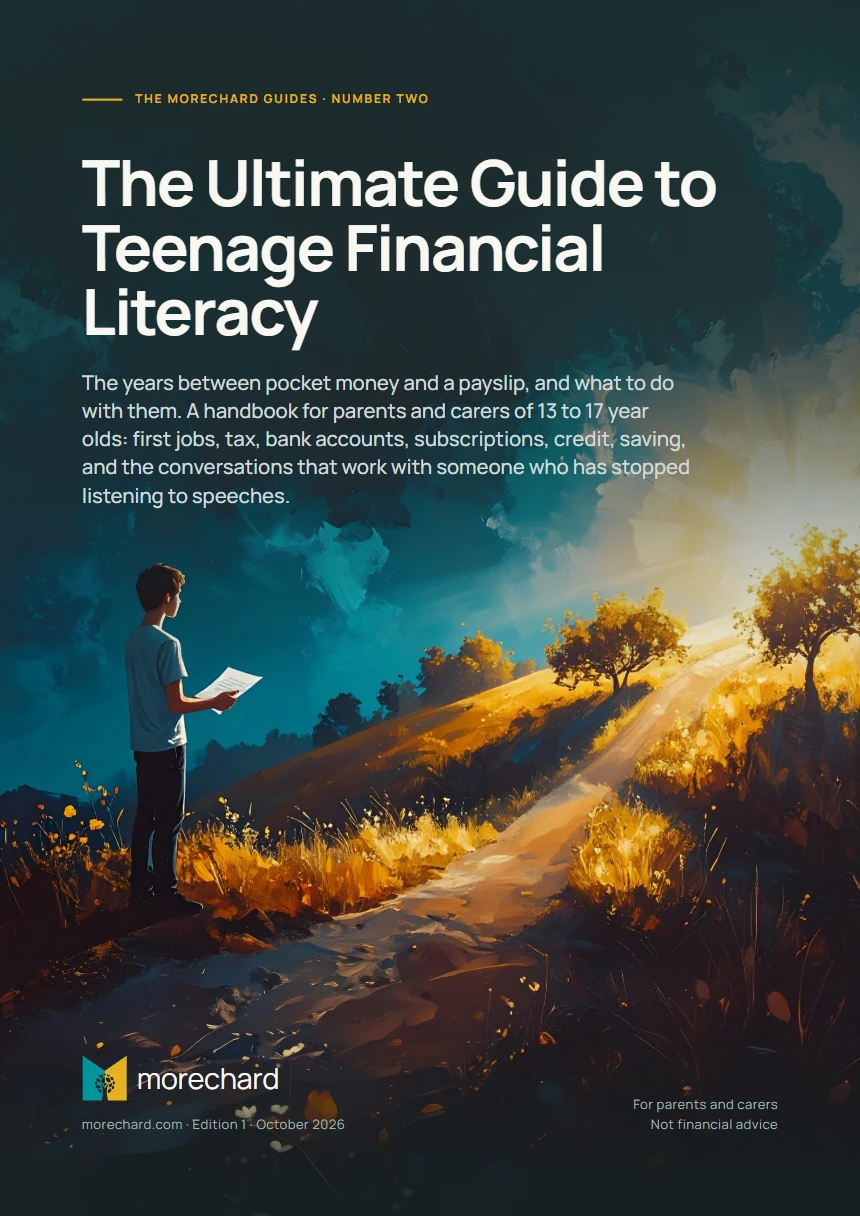
Cover of The Ultimate Guide to Teenage Financial Literacy
The guide, 33 pages. Behind it, two worked payslips.

Built on: GOV.UK, HMRC, the Money and Pensions Service, the FCA, the Bank of England, the ONS and Ofcom.

Sound familiar?

“Around two thirds of 18 to 24 year olds cannot add interest earned to a savings balance.”

In the guide: The years to fix that are 13 to 17, and the guide is built around them.

Money and Pensions Service analysis of its 2021 adult survey, cited in written evidence to Parliament in 2023. Young adults, not teenagers.
“The first payslip arrives and nobody explains it.”

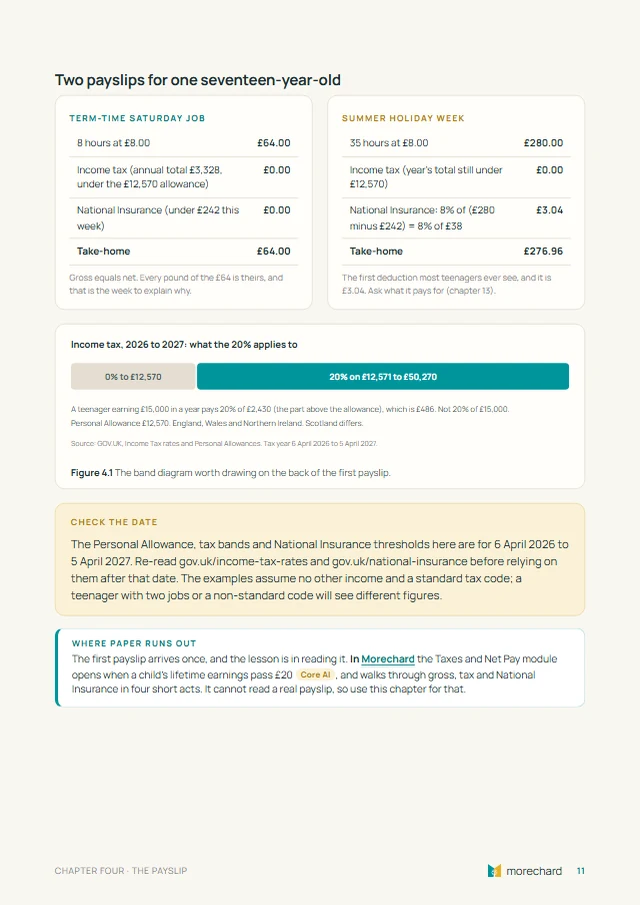
In the guide: Two worked payslips for a seventeen-year-old, the Personal Allowance, National Insurance, and the band diagram to draw on the back of it.

“They can borrow at eighteen and have never practised.”

In the guide: What credit is, what the honest evidence on buy now pay later says, and the three questions to ask before borrowing anything.

Only 59 per cent of 18 to 24 year olds know they can check their own credit report, against 81 per cent of all adults. These are not failures of intelligence. They are the result of reaching adulthood having practised almost none of it.

Source: Financial Conduct Authority, Financial Lives 2024 survey. Awareness that the option exists, not whether it was used.

What is inside

15 chapters, worked examples with real numbers, and the printable sheets at the back.

  1. The teenage gapWhat changes between 13 and 18, and what the evidence says drives capability
  2. From pocket money to an allowanceHanding over a budget: clothes, phone, the term
  3. The first jobWhat the law allows by age, hours, permits, and the minimum wage
  4. The payslipGross, net, the Personal Allowance, National Insurance, two worked examples
  5. Bank accounts, cards and money already waitingCurrent accounts, Junior ISAs, Child Trust Funds
  6. Subscriptions and the small recurringFree trials, the yearly sum, cancelling
  7. Buy now, pay later, and what credit isThe honest evidence, the three questions, credit scores
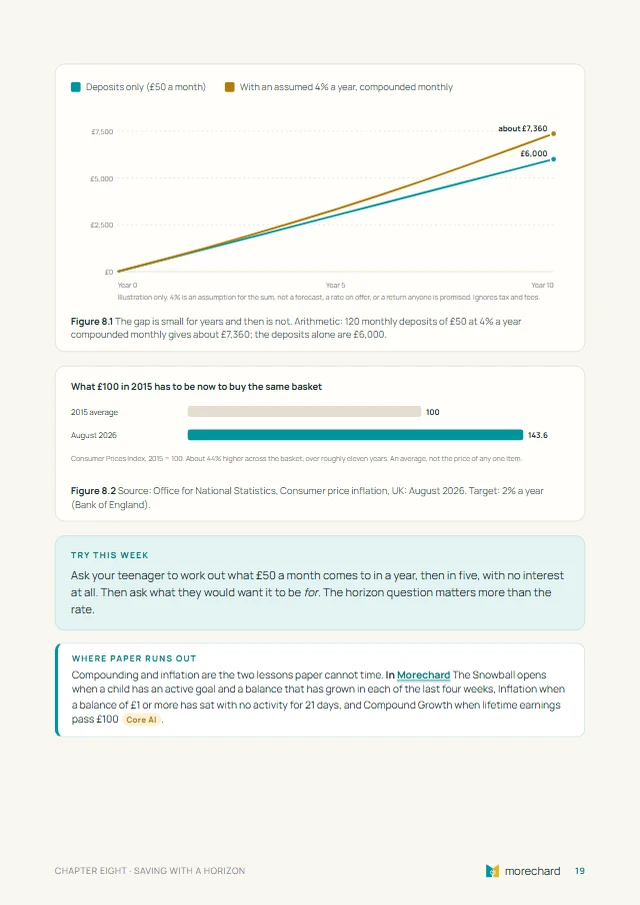
  8. Saving with a horizonCompounding, inflation, the 2% target, an illustration
  9. Spending onlineGames, surprise boxes, influencers, scams
  10. Money and moodComparison, pressure, buyer's remorse
  11. Insurance, risk and the long gameWhat protection is, what risk is, what a pension does at 22
  12. Earning moreSide projects, businesses, the gig and the salary
  13. Giving and the wider pictureWhat tax pays for; choosing to give
  14. Talking to a teenager about moneyThe register, the scripts, the moments
  15. The eighteen checklist and toolkitOne page; the term budget sheet; how Morechard fits
Page from the guide: a term-time and a holiday payslip worked through
Two worked payslips for one seventeen-year-old, line by line
Page from the guide: a line chart of 50 pounds a month saved for ten years
Saving with a horizon, with the arithmetic shown
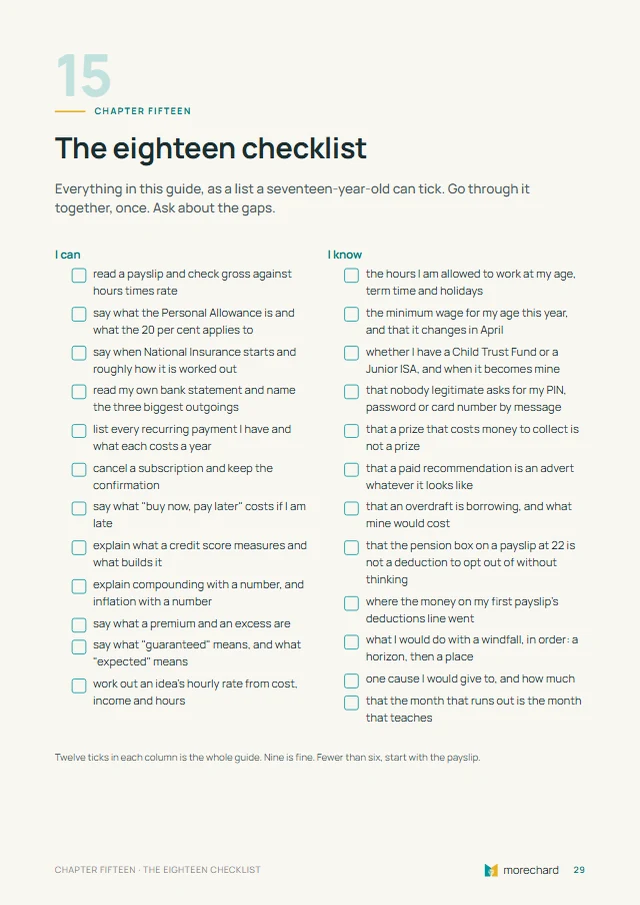
Page from the guide: the eighteen checklist
The eighteen checklist, on one page

The toolkit at the back: the eighteen checklist, a term budget sheet, a recurring payments sheet, scripts for six everyday moments, and a chapter-by-chapter map of what Morechard does.

Why this guide

Written for the UK, and dated

Every legal and tax figure comes from GOV.UK for the 2026 to 2027 tax year, and every other figure from the FCA, the Bank of England, the ONS, the Money and Pensions Service or another named source, with the year beside it. The tax figures change every April and the guide says so.

Honest about the evidence

Where a figure is about adults, it says adults. Where a study is a single study, it says so: the guide's account of what research found about buy now pay later names the sample, the country and the limits.

Practical

Two worked payslips, the band diagram to draw on the back of the first one, a term budget sheet, and short scripts for the moments that come up: the first payslip, a free trial, a purchase they regret.

No recommendations, no sales pitch

It recommends no bank, account, investment or insurer. Where Morechard is mentioned, it is in clearly marked notes you can skip.

Who it is for, and who it is not

This guide is for you if

  • You are the parent or carer of a 13 to 17 year old.
  • A first job, a payslip, a bank account or a phone contract is coming up, or has just happened.
  • You would like to handle the conversation without a lecture.
  • You want the real figures: hours, wages, tax and National Insurance.

It is not the right guide for

  • A child under 12. The pocket money guide is the one for them.
  • Tax or legal advice. The guide explains the rules and points you to GOV.UK for the details.
  • Scottish income tax rates. The guide gives the England, Wales and Northern Ireland rates and says where Scotland differs.

Who wrote it

Darren Savery

I built Morechard.

“The teenage years are the ones the timetable misses. I wanted one place that covered the lot, with the actual figures.”

What this guide will not do

  • It will not tell you what other teenagers earn or spend.
  • It will not recommend a bank, an account, an investment or a product.
  • It will not replace a conversation with your teenager. It gives you the moments and the questions.

Questions

Is it really free?

Yes. We ask for an email so we can send the link. Whether you also get our short email series afterwards is your choice on the form, and you can stop it with one click.

What exactly will you email me?

The link to the guide. If you said yes to the series, about one email a fortnight on children and money. Nothing else. We use Brevo to send email, and we never sell your address or share it for anyone else's use.

Is this financial advice?

No. It is general information for parents and carers. It explains how tax, National Insurance and credit work, and points to GOV.UK for the details that depend on your circumstances.

Do I need the Morechard app?

No. The guide works on paper and says where paper tends to run out.

Can I print it or share it?

Yes. You are welcome to print it and share it with other parents and carers, whole and unaltered. Please do not sell it or change it.

Which guide do I need?

This one is for children aged 13 to 17. For 5 to 12, there is a separate guide on pocket money. Both, if your children span the ages. The Ultimate Guide to Children and Pocket Money.

Get the guide

Thirty-three pages, two worked payslips, and the checklist to tick together. Free, by email.

Get the free guide

One field and one question. We send the link by email.

After the guide, would you like our short email series on children and money? About one email a fortnight, unsubscribe any time.

We email you the link. Nothing else to do.
By requesting the guide you confirm you are 18 or over. Privacy policy.