“Pocket money is negotiated fresh every week, from memory, and nobody agrees what was actually done.”
In the guide: The guide gives you a rate card by age and a one-page agreement, so the number is written down once.
Free guide · 30 pages · UK figures, dated and sourced
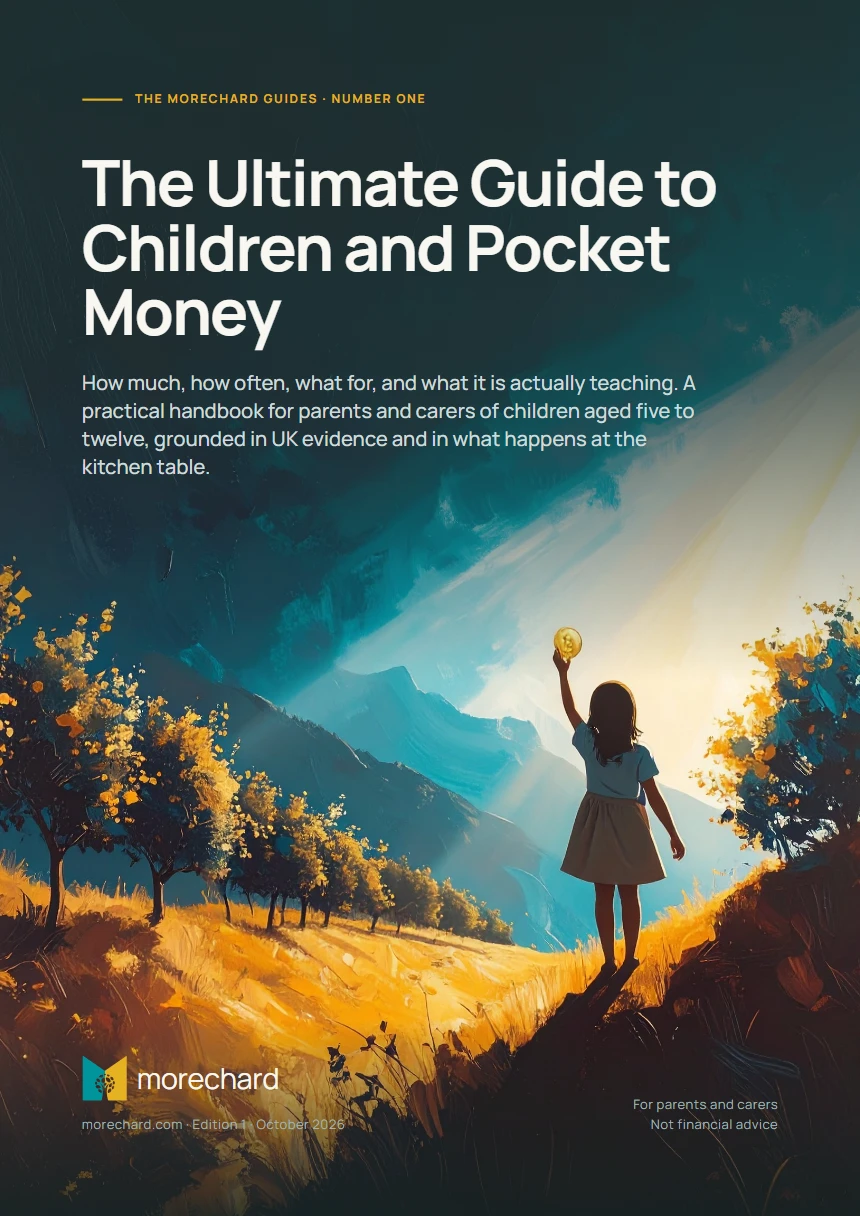
A 30-page guide for parents and carers of 5 to 12 year olds. How much by age, chores or not, weekly or monthly, what to do when it runs out, and the conversations that work. Written for the UK, with every figure dated.
30 pages, printableA rate card by ageEvery figure dated and sourced
Done.
The link is on its way to . Gmail will probably file it under Promotions, which is fair. If it is not in your inbox in five minutes, check Promotions, then junk, then email [email protected].
The first email of the series comes in a couple of days.
Ask one a night, then listen. The guide says what to listen for in each answer.
Built on: the Money and Pensions Service, GOV.UK, UK Finance, Ofcom, the Gambling Commission, the Charities Aid Foundation, and peer-reviewed research on rewards and motivation.
“Pocket money is negotiated fresh every week, from memory, and nobody agrees what was actually done.”
In the guide: The guide gives you a rate card by age and a one-page agreement, so the number is written down once.
“The chart on the fridge lasted nine days.”
In the guide: The guide explains why routines collapse, which is usually one adult holding the whole thing, and what to move out of your head.
“They want a £40 thing and have no idea what it took to earn.”
In the guide: The guide's one question, "how many of your jobs is that?", and the chapters on saving, spending and running out.
Fewer than half of UK children, 47 per cent in 2022, had what the Money and Pensions Service defines as a meaningful financial education: useful lessons at school, or regular money at home with rules and responsibility for spending it. Only one in ten had both, and that group managed money best. The guide is the home half.
Source: Money and Pensions Service, UK Children and Young People's Financial Wellbeing Survey, 4,740 children aged 7 to 17, 2022.
13 chapters, worked examples with real numbers, and the printable sheets at the back.
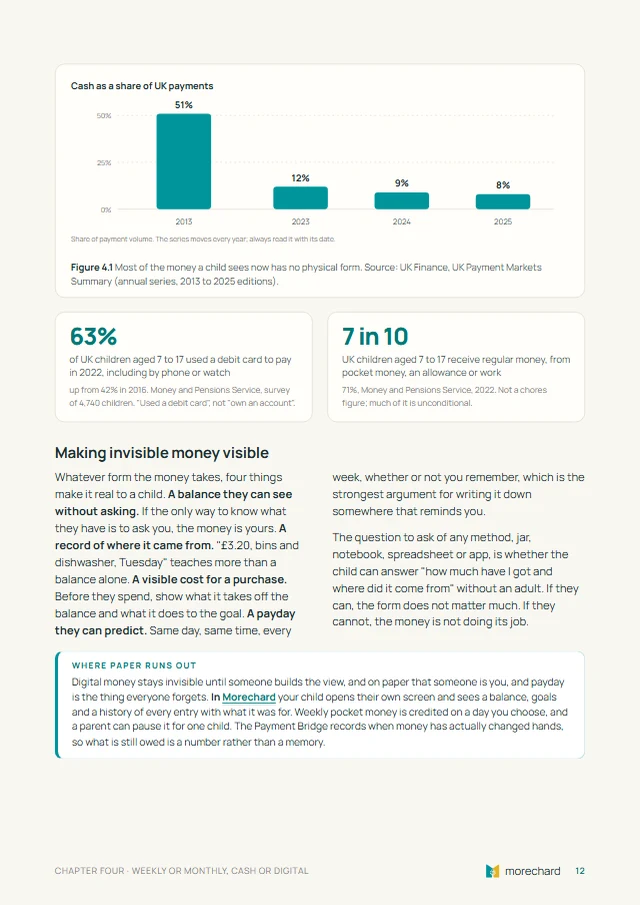
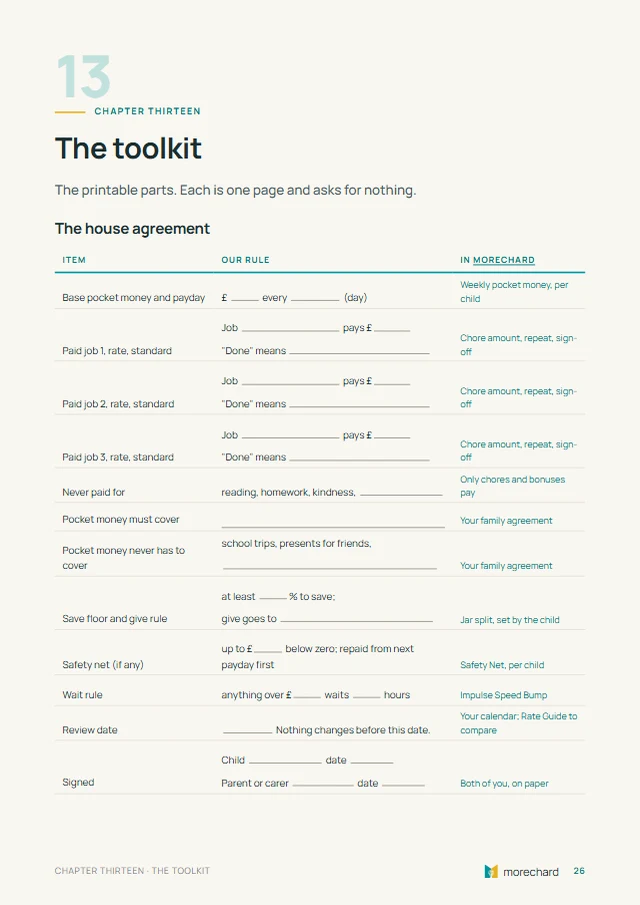
The toolkit at the back: the house agreement, the rate review worksheet, five questions for five nights, and a chapter-by-chapter map of what Morechard does.
Every figure comes from GOV.UK, the Money and Pensions Service, UK Finance, Ofcom or another named UK source, with the year beside it and a sources page at the back. Where a figure will go out of date, the guide says so.
It tells you where the popular version is wrong: the marshmallow test, the "Harvard chores study" (it is a Minnesota study of 84 children), and "money habits are set by seven". It also takes the best evidence against paying children for chores seriously, then shows the design that avoids the trap.
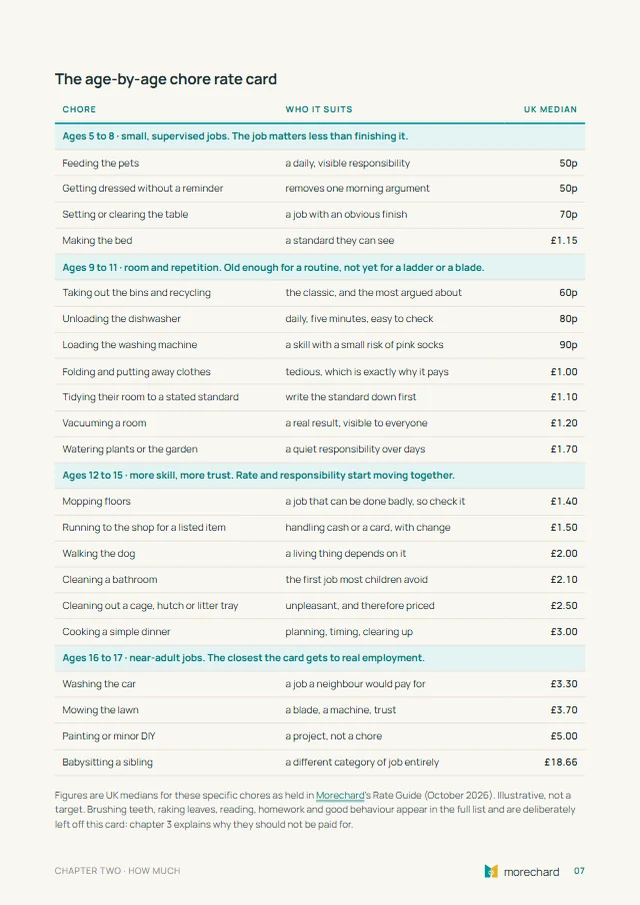
Worked examples with real numbers, scripts for the conversation at each age, and printable sheets: a house agreement, a rate review worksheet and five questions for five nights.
It does not quote a national pocket money average, because an average is the wrong tool. It recommends no bank, account or app. Where Morechard is mentioned, it is in clearly marked notes you can skip.
Yes. We ask for an email so we can send the link. Whether you also get our short email series afterwards is your choice on the form, and you can stop it with one click.
The link to the guide. If you said yes to the series, about one email a fortnight on children and money. Nothing else. We use Brevo to send email, and we never sell your address or share it for anyone else's use.
No. It is general information for parents and carers, and says so wherever it could be mistaken for advice.
No. The guide works on paper and says where paper tends to run out.
Yes. You are welcome to print it and share it with other parents and carers, whole and unaltered. Please do not sell it or change it.
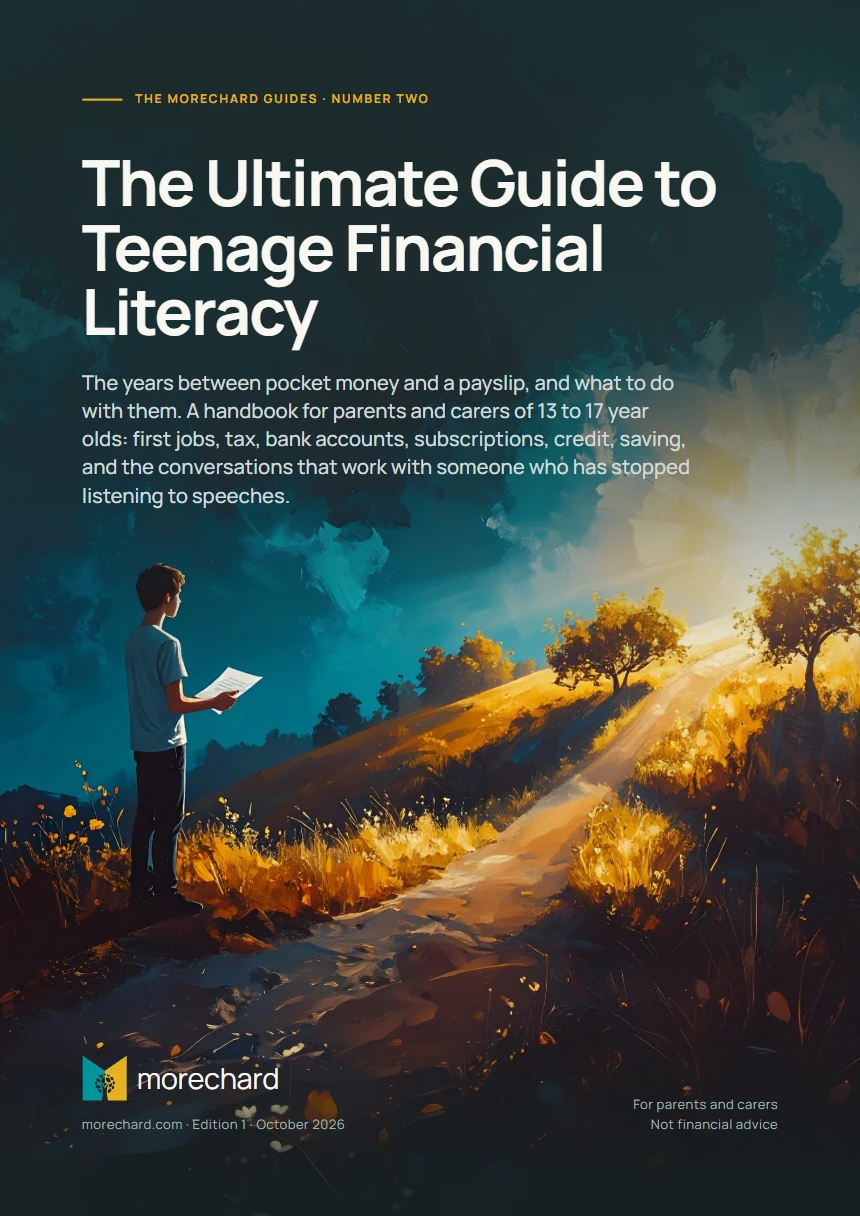
This one is for children aged 5 to 12. For 13 to 17, there is a separate guide on first jobs, tax, bank accounts and credit. Both, if your children span the ages. The Ultimate Guide to Teenage Financial Literacy.
Thirty pages, the rate card, and the sheets to print. Free, by email.
Done.
The link is on its way to . Gmail will probably file it under Promotions, which is fair. If it is not in your inbox in five minutes, check Promotions, then junk, then email [email protected].
The first email of the series comes in a couple of days.